Immersive viewer on Apple Vision Pro
True-stereoscopic tumor surfaces with hand-driven slice-plane manipulation — reviewed at scale in the surgeon’s own space. Meta Quest 3 support is under evaluation.
NeuroStage · Surgical Planning on Apple Vision Pro
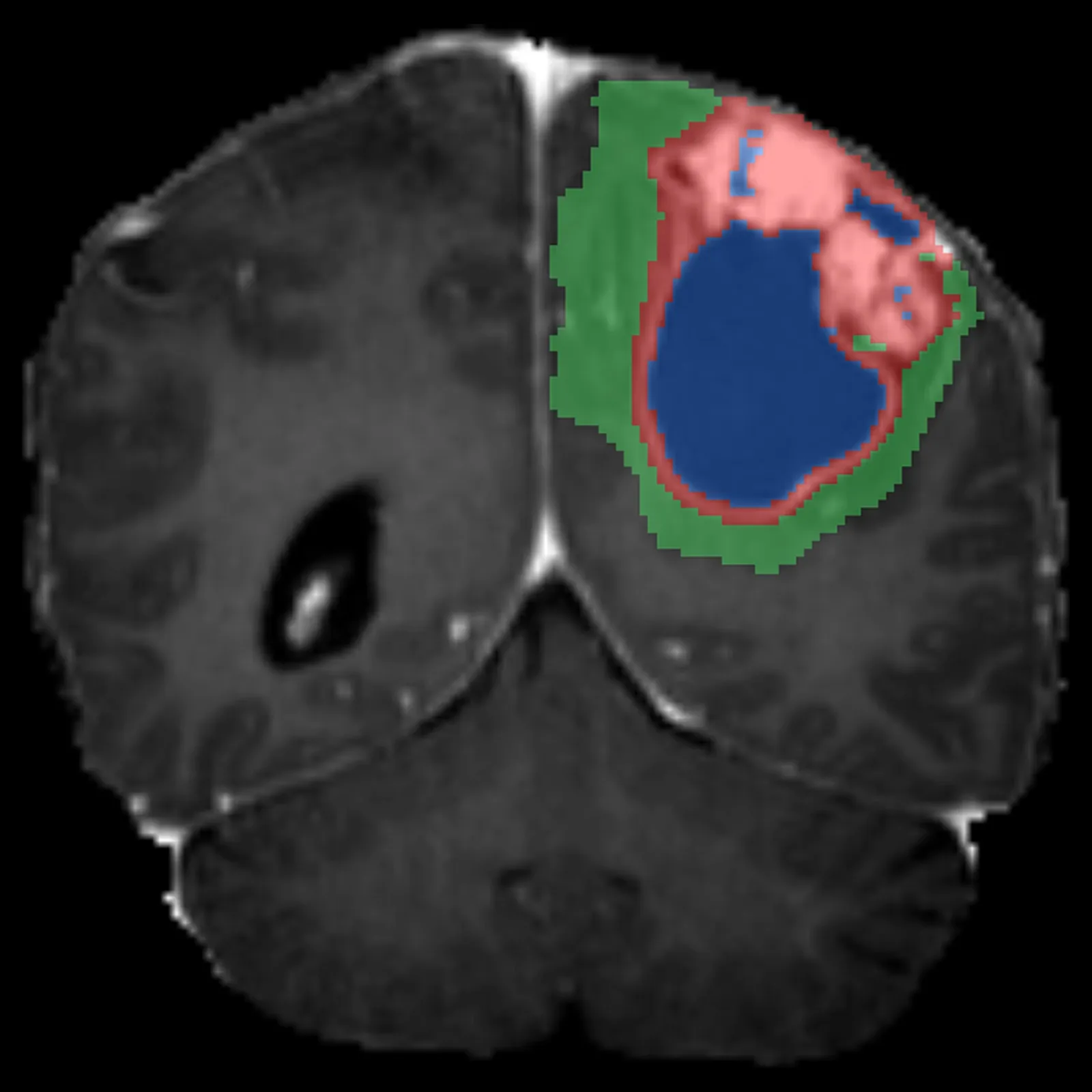
Automated brain tumor segmentation powered by OncoAI, delivered as surgeon-ready 3D models — walk around the tumor in true stereoscopic space, straight from a DICOM upload.
Research Preview — not FDA cleared. For research and surgical-planning rehearsal only; not for clinical diagnosis or intraoperative guidance.
The clinical gap
Brain tumor planning is three-dimensional reasoning — lesion morphology, eloquent-area proximity, approach trajectory. Yet pre-operative review is still conducted slice-by-slice on 2D MRI, leaving the surgeon’s mental 3D reconstruction as the rate-limiting step. Existing 3D tools demand manual segmentation, desktop-only workflows, or single-user review.
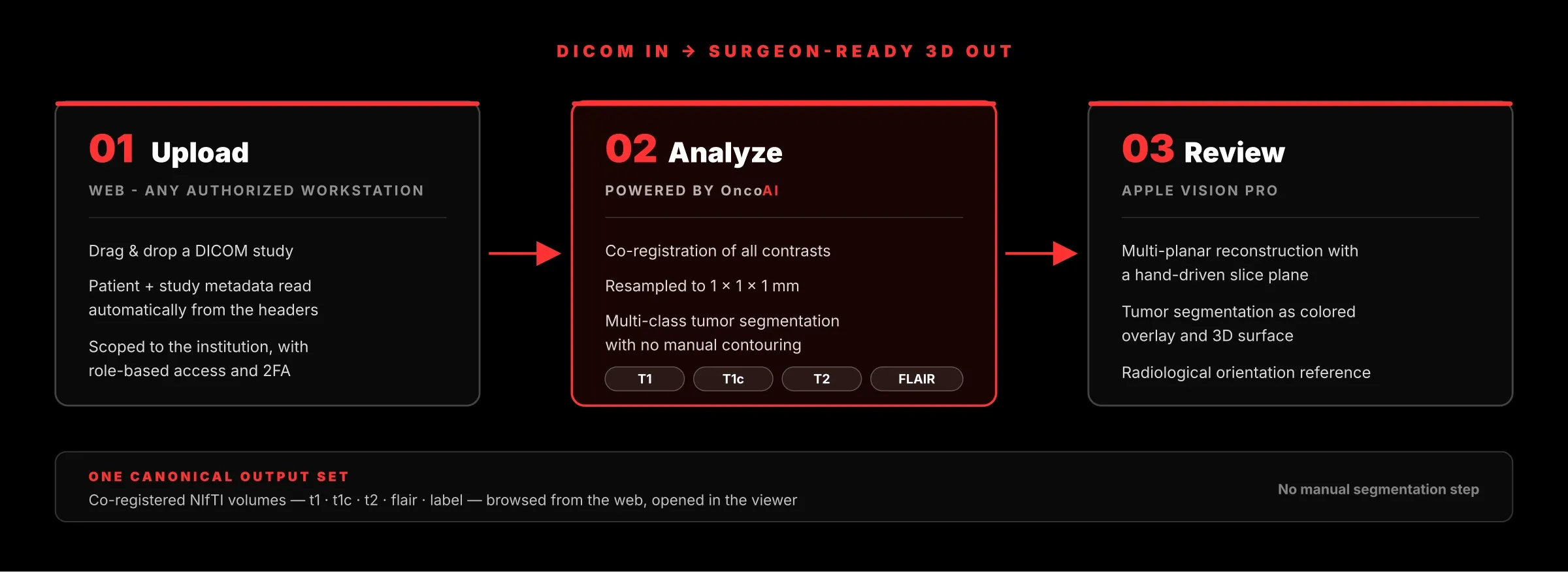
NeuroStage closes the gap by pairing Carina’s automated brain tumor segmentation with an immersive spatial viewer — delivering surgeon-ready 3D models directly from a DICOM upload.
How it works
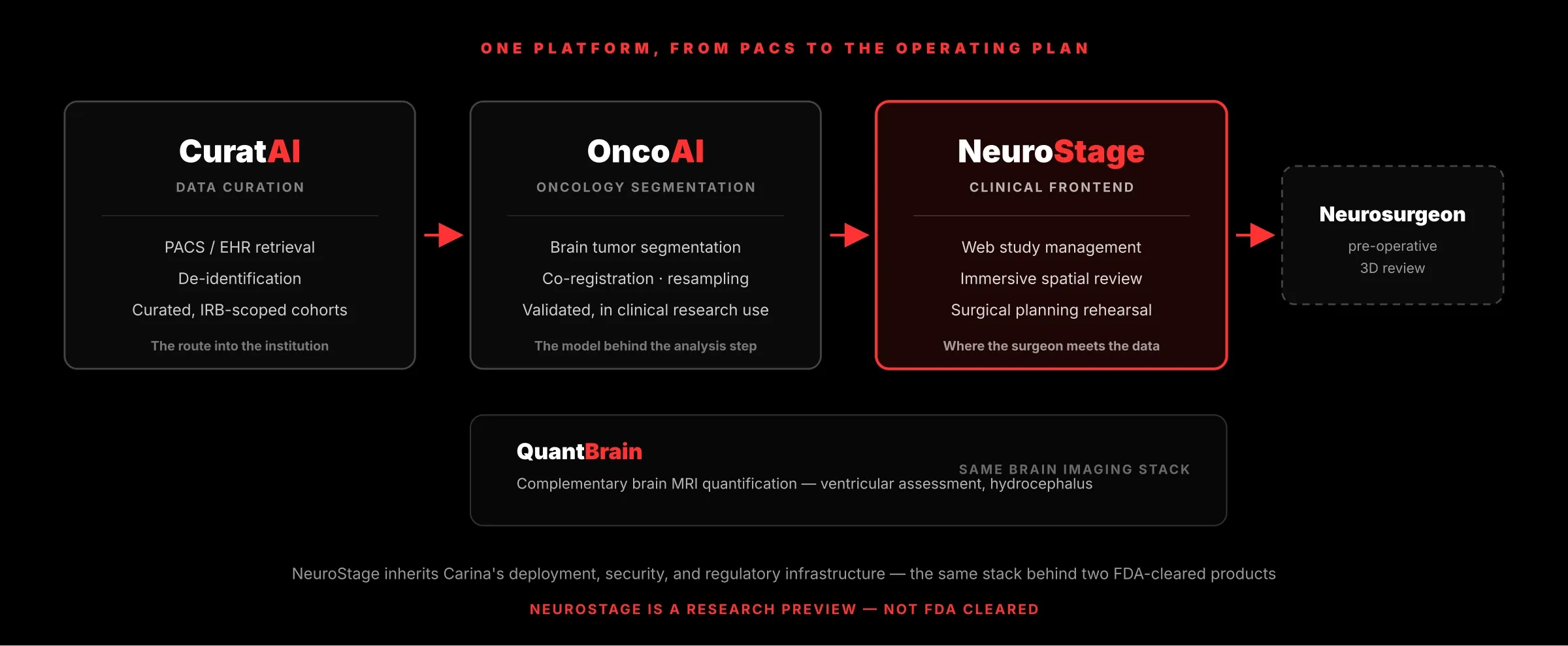
NeuroStage is the clinical-frontend tier of Carina’s brain-imaging pipeline: upload a study from the web, OncoAI runs the analysis, and the result is available immediately in both the web browser and the spatial viewer — no manual segmentation step.
Automated segmentation
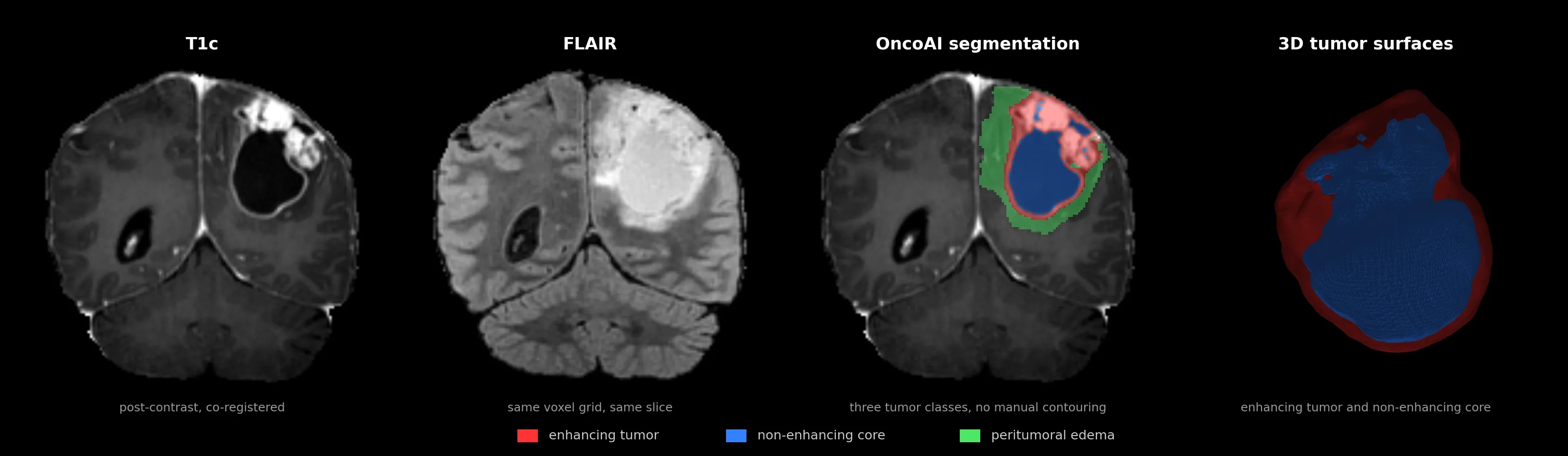
OncoAI co-registers the MRI contrasts to a common 1×1×1 mm grid and produces a multi-class label — enhancing tumor, non-enhancing core, and peritumoral edema — that drives both the 2D overlay and the 3D surfaces the surgeon reviews.
Key capabilities
True-stereoscopic tumor surfaces with hand-driven slice-plane manipulation — reviewed at scale in the surgeon’s own space. Meta Quest 3 support is under evaluation.
OncoAI’s brain tumor model produces multi-class labels — enhancing tumor, non-enhancing core, peritumoral edema — with no manual contouring.
T1, T1c, T2, and FLAIR co-registered to a common space, with on-the-fly contrast switching on the same slice geometry.
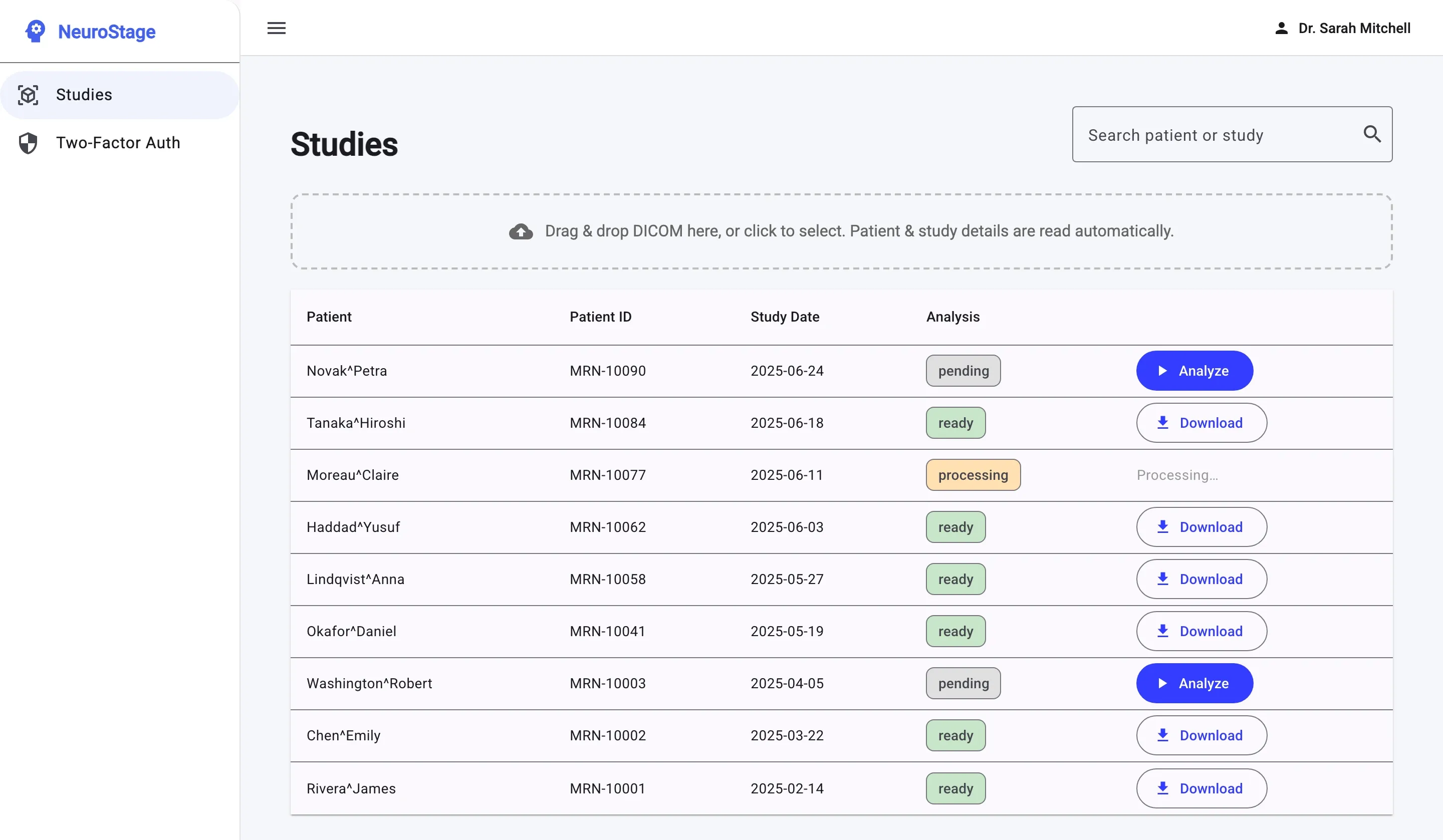
Institution-scoped study list, secure DICOM upload and download, role-based access, and 2FA — from any authorized browser.
On-premise or HIPAA-eligible cloud deployment. Integrates with CuratAI for PACS curation and de-identification upstream.
Every study resolves to co-registered NIfTI volumes plus a tumor label — browsed from the web, opened in the spatial viewer, no per-site install.
The management surface
Integrated with the Carina platform
NeuroStage is the surgeon-facing surface of a pipeline that starts at the PACS. It inherits Carina’s deployment, security, and regulatory infrastructure — the same stack behind two FDA-cleared products.
Deployment
Study upload, status, management, and lightweight review — any modern browser.
Immersive 3D review and surgical rehearsal — Apple Vision Pro (Meta Quest 3 under evaluation).
Carina’s standard server stack, with optional on-premise deployment for data-residency requirements.
Status
Research Preview — not FDA cleared. NeuroStage is available to selected academic medical centers under early-access agreements for research and surgical-planning rehearsal. It is not intended for clinical diagnosis or intraoperative guidance. Clinical validation work is underway.
For academic neurosurgery departments exploring surgical-planning rehearsal and neurosurgical training.