Now at SIIM 2026 · Startup Kiosk 3 · June 10–12

About

What we build, and why

Clinical-research software built by clinician-engineers — used at 10+ academic medical centers, behind two FDA 510(k)-cleared products, backed by NIH SBIR awards and granted patents.

Where we come from

We were the users before we were the vendor

Carina AI spun out of research labs at the University of Virginia and the University of Kentucky. A radiation-oncology medical physicist and a biomedical engineer who were tired of the friction in their own clinical-research work — the months lost to de-identification, and the methods that won grand challenges and got published but never made it to a patient.

NIH SBIR awards funded the research. The methods became products. Two of them — INTContour and INTDose — are FDA 510(k)-cleared and in clinical use today. The team that built the sharp innovations is the team that supports them.

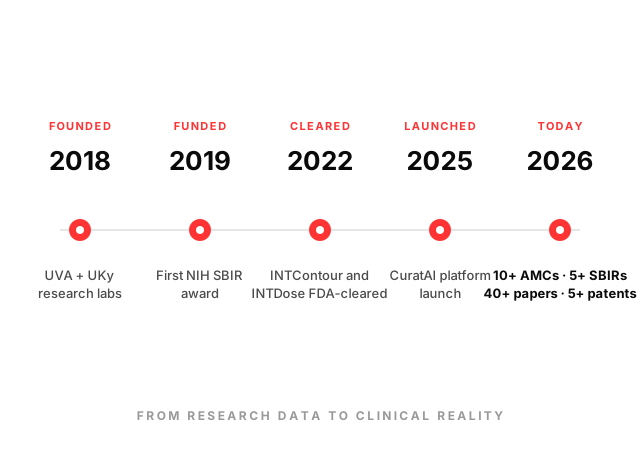
Carina AI timeline — 2018 founded in research labs, 2019 first NIH SBIR award, 2022 INTContour and INTDose FDA-cleared, 2025 CuratAI platform launch, 2026 10+ AMCs and 5+ SBIRs

The arc

From research data clinical reality

Clinical reality means an FDA-cleared product that changes practice, plus the peer-reviewed methods and validation work that got it there. Research by itself doesn't change clinical practice. The company is built around getting from one to the other, and the platform, the publications, and the deployments are the work along the way.

The middle of the arc

Clinical data is messy, fragmented, and full of patient privacy

That's what makes the journey from research data to a cleared clinical product hard — and what most teams either rush through or get stuck on.

The engineering you can't skip

To get raw clinical data to a cleared product, every step in the middle has to be done well.

  • Reorganize fragmented data — across PACS, EHR, pathology, registries, and local uploads — into research-ready cohorts
  • Extract structured fields from free-text notes, reports, PDFs, and images
  • Annotate at scale — with AI assistance, multi-user review, and inter-observer tracking
  • Quality-check AI outputs against expert ground truth
  • Develop novel AI — the methods that didn't exist before
  • Navigate FDA — 510(k) submission, QSR, post-market — when the product touches clinical care

The privacy you can't trade away

Every step above runs on patient data — and the privacy guarantees can't be sacrificed for convenience or speed.

  • Pixel-level PHI in radiology, ultrasound, and pathology slides — not just DICOM headers
  • 3-D facial geometry on CT and MRI head scans — re-identifiable without proper defacing
  • Burned-in text on images — measurements look like PHI; PHI looks like measurements
  • IRB and HIPAA constraints on what crosses an institutional firewall
  • Audit trails for every transformation, with reversible re-identification kept on your storage
  • On-premise execution — the data doesn't leave the institution at all

Speed and privacy together, all the way through every product. Both engineering and privacy carry across the full arc — that's the bar we hold.

What we built

A product or service at every stage of the arc

On one on-premise stack. Under the same privacy guarantees.

  1. 1

    Research output

    The methods our products run on — 40+ peer-reviewed publications, 5+ granted US patents, 5+ NIH SBIR awards. Founded by clinician-engineers in research labs at UVA and University of Kentucky.

  2. 2

    Data infrastructure

    CuratAI — the on-premise clinical-research data platform. Multi-source retrieval, pixel-level de-identification, AI-assisted annotation with quality checks, local LLM structured-data extraction, cross-institution sharing without exporting raw data.

  3. 3

    Clinical AI methods research-grade

    OncoAI Suite for tumor detection and tracking, QuantBrain for ventricle quantification. Used in research today; FDA pathway in progress.

  4. 4

    FDA-cleared clinical products

    INTContour (510(k) K212274, cleared 2022) — AI auto-contouring for radiation oncology. INTDose (510(k) K213137, cleared 2022) — Monte Carlo dose verification.

  5. 5

    Partner services

    Partner with us — we walk the same arc with research groups, AMCs, and medical-device companies on our team and stack. Data curation, annotation, custom AI development, and regulatory pathway support.

The customer arc

Our products let customers walk their arc, too

Same engineering and privacy commitments, applied to your data, your cohort, your clinical question.

CuratAI · custom AI plugins

Drop your own AI models into CuratAI's plugin slot. Run them on your de-identified cohort, on your hardware, inside your firewall. Your research question, our stack, your model.

INTContour · custom-model training

On top of the FDA-cleared base models, train your own segmentation models on your own institutional data. The Mayo Clinic comparison study shows institution-trained models outperform vendor baselines on the institution's protocols. (Custom-trained deployment is research-use; the cleared models stay separately validated.)

AI Development & 510(k) Services

When a partner wants a custom product walked end-to-end through the arc, we apply the same know-how — custom AI development, regulatory pathway support, custom deployments.

Proof we're walking it

A research company that became a product company

  • 10+ Academic medical centers Mayo · JHU · Penn · UVA · Duke · Emory · City of Hope · Colorado · Brown · UTSW · Kentucky — customers and research collaborators
  • 2 FDA 510(k)-cleared products INTContour K212274 and INTDose K213137, both cleared in 2022 and in clinical use
  • 40+ Peer-reviewed publications Methods reviewed by the customers' peers, across 2018–today
  • 5+ Granted US patents Facial defacing, AI segmentation, semantic text de-identification, smart interpolation — plus pending applications
  • 5+ NIH SBIR awards Phase I and Phase II awards funding the research behind our products

Used at — customers who renewed, not logos we bought

  • Mayo Clinic
  • Johns Hopkins University
  • University of Pennsylvania
  • Duke University
  • University of Virginia
  • Emory University
  • City of Hope
  • University of Kentucky

Where we're going

Every clinical-research question — answered in weeks, on the institution's own data

Today, a single multi-site imaging study can take eighteen months because the data can't safely move between institutions, the PHI in the pixels can't be removed without breaking the science, and structured extraction has to be hand-built for every registry. The future we want is the inverse: every clinical-research question — whether it confirms a treatment or rules it out as evidence against — reaches a patient in weeks instead of years. Without ever asking the institution to give up its data.

Meet the team

The clinician-engineers behind Carina AI.